 |
 |
 |
|
Mid 50s Single Coils
The Birth of a Classic
Our Mid 50s single coils capture the very essence of the earliest Strat® tones — a turning point in electric guitar history that defined what a Strat could sound like. These pickups are rooted in 1954, the year the Stratocaster® first appeared, and they carry the charm, brightness, and clarity that made early rock, country, and blues instantly recognisable.
Wound with 42 AWG Formvar insulated copper to roughly 5.5–5.7KΩ and fitted with 3/16” poles, the Mid 50s pickups give that quintessential sparkling tone, with just the right amount of twang, bite, and responsiveness for clean and slightly driven playing alike.
A Little Potted History
1954 was a transformative year. The Tele® had already carved its place, but the Strat® turned heads with its contoured body, three single coils, and tremolo bridge. It wasn’t just a new guitar — it was a statement. Rock & Roll was evolving, and the Strat® was ready to ride that wave, perfectly matching the energy of teenagers hungry for fresh sounds.
Early Tone Characteristics
These first pickups were bright, lively, and slightly nasal compared to later 50s models — perfect for clean lines and articulate chord work. The 5.5–5.7KΩ resistance gave players clarity and definition, while Formvar wire ensured a smooth, balanced response. Amped lightly, they sparkle; pushed a bit harder, they break up into a sweet, singing overdrive.
The 1954 Strat in Action
These pickups thrived in the hands of musicians exploring the edge between country’s clean twang and the burgeoning energy of rock. They respond beautifully to dynamics, capturing every nuance from gentle picking to aggressive attack, making them versatile for a wide range of blues, rock, and classic Strat® tones. The tone is lively but not harsh, articulate yet warm, capable of both sparkling single-note runs and full, rich chords.
Why Mid 50s Pickups Matter
For players chasing that early Strat® vibe, these pickups are a cornerstone. They aren’t designed to sound “warm and smooth” like the Late 50s, not as they as "rasping and driven" as the Late 60s, but they excel at clarity, articulation, and expressive dynamics. Perfect for blues, rockabilly, surf, and early rock & roll, they bring a historically accurate tone that’s just as compelling today as it was seventy years ago.
Light, bright, articulate, and highly responsive — these are pickups that let the guitar sing in its purest, earliest Strat® form.
Fender®, Squier®, Stratocaster® and Strat® are registered trademarks of Fender Musical Instruments Corporation and Axesrus® has no affiliation with FMIC
Ever heard that Formvar makes a pickup warmer? We bust the myth and explain why insulation thickness and coil geometry matter more than the colour of the wire.
The topic of pole stagging on single coil pickups, is given alot of air time - and whilst it matters for some, for most of us? Is it really worth worry about?
One of my pet peeves with pickups, is the idea that we must, strictly, adhere to one brand, one set, one style, and whilst it has its charms, i think theres more to it then that.
This one crops up from time to time, and honestly, there’s no straight answer. But here’s a bit of context so you’re slightly better informed.
Why Staggering Exists
Traditionally, single coil pickups come with staggered poles: E and A at 17.5mm, D and G at 18mm, B at 16.5mm, and high E at 17mm. This idea has been around since the very first Stratocasters, and exists purely to “balance” the strings. Wound strings are quieter than plain strings because they contain less steel within their nickel wraps, and with 7 1/4" radius necks of the ’50s, the strings sat further from the pickup face.
Interestingly, the earliest Strat pickups used a slightly different staggering — the G string was 17.5mm, which made wound Gs of the time a little quiet. This was phased out in 1956 for the “normal” staggering we see today.
Why It Still Matters
Even though wound Gs are now rare, and modern necks are flatter with lower actions, staggering persists because… well, it’s the sound we’ve come to expect. Pickups with staggered poles have been used since 1954 to make all the music we know and love. It may no longer be strictly necessary, but it sounds right — so we stick with it.
The Exception: Ultra-Flat Necks
For necks with 12", 14", or compound radii, staggering can actually cause more imbalance than it corrects. Flat-radius necks, or HSS/HSH setups, often benefit from non-staggered poles, giving more consistent string volume across the pickup.
Summary
-
Vintage replicas & warts-and-all reissues: Staggered poles are ideal.
-
Modern guitars based on old designs (7 1/4"–9 1/2" radius): Staggering still works.
-
Ultra-flat necks, HSS/HSH setups, very low action: Non-staggered poles give the most consistent results.
In short: staggering isn’t “better” or “worse,” it’s just part of the tradition — and a subtle factor in that classic Strat sound.
Right then – I’ll concede this can be confusing, but there is some logic to it. Let’s break it down.
What’s a “Matched Set”?
In our world, a matched set means three pickups that share the same resistance, inductance, magnets, and so on — just like Fender did back in the 1950s. That was the norm right up until the ’80s. (Even now, the idea of “position-specific” pickups is more of a pickup maker’s invention than a guitar maker’s standard.)
So, a Late-50s set? They’re all going to be 6K, Alnico 5. Simple.
Vintage vs. Modern
We offer two flavours of sets — you could think of them as “Vintage” and “Modern”:
-
Vintage = middle pickup not reverse wound. This follows pre-1977 spec, when Fender never used reverse-wound middles (and rarely did until the early ’80s).
-
Modern = middle pickup is reverse wound. This is the now-familiar hum-cancelling option for positions 2 and 4 on a 5-way switch.
Why it Matters
A reverse-wound middle sounds identical to a standard one on its own. The difference shows up in positions 2 and 4:
-
With a reverse-wound middle, you get hum-cancelling and the “modern” Strat sound most players know today.
-
With a standard middle, you get the thinner, phasey, “broken magic” sound of early Strats. Louder, a bit jankier, and very characterful.
Neither is right or wrong. Both are usable, both sound great — it just depends on which flavour you prefer.
Buying Singles
I’m all for mixing and matching — it’s one of the best ways to personalise a guitar. So, here’s how to make sure everything plays nicely together.
Winding Direction
-
Standard (not reverse wound) = clockwise wind, south polarity. Black wire on the left, white on the right (if the pickup’s in your hand, bottom flatwork down, wires facing you).
-
Reverse wound = counter-clockwise wind, north polarity.
Different makers don’t always stick to the same standard, so it’s worth checking.
Polarity
Our standard is South top (reverse wound = North top).
Easiest way to check polarity:
-
Hold a compass near the pole pieces.
-
If the north needle points at the pole, that pole is South top (yep, confusing, but true).
There are also free polarity checker apps for smartphones.
Mixing and Matching
On the whole, single coils (phase and polarity aside) tend to play very nicely together. That’s why we primarily offer our pickups as stand-alone items — it gives you the freedom to mix and match different voices, different styles, and cover more ground.
Of course, going for a perfectly matched set is a fantastic option, especially if you want to “walk a mile in their shoes” with a period-correct or artist-inspired build. But remember — this is your guitar, and your music. If you think a smooth, brassy Mid-50s in the neck would pair beautifully with a biting, sleazy Texas Blues in the middle? Go for it. It’ll work, and it’ll sound great.
Humbucker Compatibility
This is where things can get a little more particular.
A humbucker is made of two coils:
-
Slug coil = clockwise, north.
-
Screw coil = counter-clockwise, south.
When coil-splitting, most guitars tap to the slug coil, which leaves you with a clockwise, north coil live.
If you want that to behave correctly with a single coil in position 2 (HSS guitars), the middle pickup has to be specifically built to suit (counter-clockwise, south).
Rather than force the middle pickup spec, we usually adjust the humbucker. All of our humbuckers can be ordered with magnet polarity reversed for exactly this situation. It’s the cleanest, most reliable way to get everything in phase.
For HSH setups, the same logic applies — you either need a middle pickup wound for humbucker compatibility, or you need to order your humbuckers with the right polarity. We’re happy to do that, just ask.
Is Formvar Warmer?
If I had a pound for every time I’d been told “Formvar wire makes pickups warmer,” I’d be typing this from a yacht. It’s one of those half-myths that crops up so often it’s become gospel. Since we actually do use Formvar on a few models, this is as good a place as any to set the record straight.
What Formvar Actually Is
When we talk about “Formvar wire,” “plain enamel,” “polysol,” or whatever else — we’re really just talking about copper coated in a thin layer of insulation. That’s it. The copper does the work, the insulation stops coil turns from shorting out. In theory, you could coat it in cheese and it’d sound the same.
So why the fuss? Because Formvar isn’t magic, but it is different.
Insulation Thickness (The Real Reason)
Formvar is only made as heavy build insulation. That means the insulation layer is thicker than what you get on most other 42 AWG wires (plain enamel, polysol etc. are usually “single build”).
-
The copper core is the same (0.0635mm), but the insulation makes the overall wire diameter larger.
-
That thicker insulation means fewer turns fit on the bobbin.
-
Each layer of the coil also sits slightly further away from the magnet’s strongest field.
The result? A coil that’s geometrically different, even if the resistance comes out the same. And yes — that shift can make the pickup lean a little warmer and smoother compared to single-build wires.
It’s not magic orange dye — it’s just insulation thickness changing the coil geometry.
Wire Diameter (The Pitfall)
Here’s where it gets messy. True 42 AWG heavy build Formvar is rare and expensive — it basically only exists for pickup winding. That hasn’t stopped some manufacturers (and winders) from calling any old orange-insulated wire “Formvar.”
Often what you’ll actually find is metric 0.06mm wire with single build insulation. That’s the perfect storm of “wrong”: the core is smaller, the insulation is thinner, and the result won’t behave like real 42 AWG Formvar at all.
Reality Check
Historically, Formvar only really appeared in mid-50s Stratocaster and early Jazz Bass pickups. That’s it. And it’s brilliant in that role — it’s why mid-50s single coils have their distinctive smoother top end.
But it’s also a pain to use: the thick insulation limits how much wire you can fit. You’ll never see a proper 8k humbucker wound with Formvar — if someone claims they’ve done it, have a word with their wire supplier.
Horses for Courses
So, is Formvar “warmer”? Technically, no. But practically, yes — because heavy build insulation changes coil geometry, and no other 42 AWG wire is made this way.
Use it in a Strat pickup wound to around 5.5–6k and you’ll nail that bluesy mid-50s tone. Use it in a humbucker or P90? Wrong tool for the job. If you see someone selling “Formvar humbuckers,” tread lightly.
How We Build
All Axesrus pickups are custom made. When you click “Add to Cart,” there’s nothing on a shelf. Each pickup is built entirely from scratch, to the specifications you choose — even our “standard” designs are built to order.
The process is entirely in-house: parts are collected, coils are wound, pickups are soldered, tested, wax-potted, cleaned, and retested. Production is small-scale — at most 6 pickups a day — which allows for exceptional attention to detail. Lead times are typically around 2 weeks, but queues vary depending on demand.
Returns
Because each pickup is custom-built for you, they cannot be returned or refunded. Once a coil is wound, the pickup belongs to you. There’s no “test it and return if you don’t like it” — it’s custom work, and that’s explicitly covered under UK distance selling regulations.
Warranty
All Axesrus pickups come with a relaxed lifetime warranty. No registration required, support is offered regardless of resale, and we don’t limit it to the first 12 months.
Realistic expectations:
-
Manufacturing faults: We will repair or replace any pickup that develops a genuine fault within a reasonable timeframe. Older, very low-cost early pickups may not fall under free repair, but we’ll offer assistance at a fair price.
-
Damage vs fault: Pickups are delicate. Minor damage from install or shipping is generally treated as a fault, but heavily damaged, worn, or intentionally broken pickups are not covered.
-
Lead times & cancellations: Custom builds cannot be cancelled once work has started. Production follows a first-in-first-out queue.
-
Modifications: We can modify pickups post-purchase (magnet changes, cover swaps, wire updates) for the cost of parts and postage, at our discretion.
Second-hand & transferred pickups:
-
Warranty generally follows the original purchaser, but we can extend reasonable support for 12 months post-purchase to new owners with proof of original sale.
-
Technical support is offered regardless of time since purchase, provided the product is confirmed as an Axesrus pickup.
Specifications & Tolerances
Pickups are measured and tested to published specifications, but slight variations can occur due to wire, alloy, or temperature changes. Minor deviations are not considered a warranty claim.
Warranty Postage
Outside the initial 14 days, postage for repairs or replacements is at the customer’s cost. International shipping can be prohibitive, so please take this into account.
String Spacing = 52.8m Wiring = Black - Ground, White- Live Resistance = 5.7k(+/- 5% ) Inductance - 2.5 Henries @1Khz (+/- 5% ) Magnets = Alnico V Pole Style = Staggered & light Bevel Wire = .42 Gauge Formvar Wound by hand, in the UK 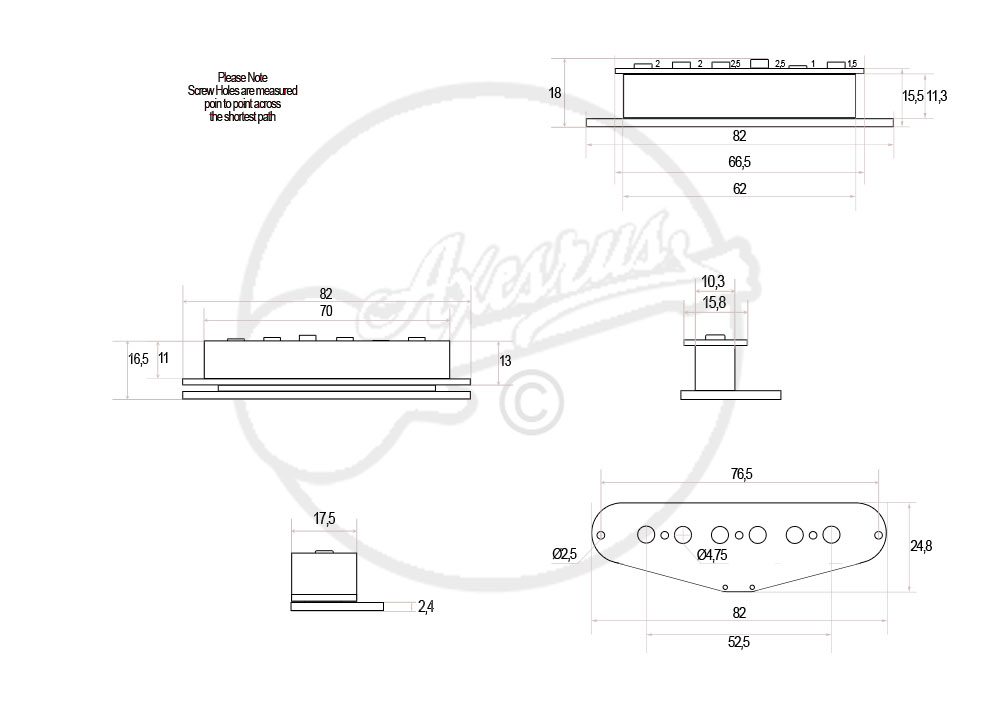
|
|
|
 |
|
 |
|

