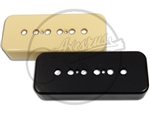
Description
Sound Clips
The Good & The Bad
Bode Plots
Setups
Warrenty & Returns
Specifications
Hot Iron
They’re a set of pickup that have been on the books for as long as most of us have worked here, and a bit an oddity that made it across from the "old" Axesrus® – they never really fitted into the company ethos of days gone by, and honestly, I don’t think many of the old guard played them!
But with the company moving in a new direction, and a bit of you blood coursing through the veins, they proved themselves time and time again for that more modern humbuckers tone, and we're all in agreement that they’re well over due a bit of an update
Essentially, your Hot Iron is an overwound bridge humbucker - an absolute monster that just doesn't compromise in its pursuit of distortion, it’s a fantastic setup, allowing you to switch from big, face blistering riffs and solos to sweet and soulful chord progressions or flowing sweep picked arpeggios with no real drop in output.
Because of the innovative design, whist technically, you’re getting a high output pickup here, and you’re still getting alot of that definition, response and natural breakup you’d expect when playing such an aggressive pickup. You get great note separation, fantastic bite and growl in the lower end, and that all important mid-range that’s essential when you’re playing under a lot of gain.
Gibson®, Epiphone®, Stratocaster® and Strat® are registered trademarks of Fender Musical Instruments Corporation and Gibson Musical Instruments Corporation. Axesrus® has no affiliation with FMIC
Between you, me and the fence post, I'm more an engineer then i am a salesman, so to scratch that itch - I’m compelled to not only write up the unavoidable "hey, this pickup great! Play Rock or Blues?! This one’s for you!", but for the sake of balance, it’s only fair that I get to write up what they're not great at too (and because this section isn't "up front" - I get to be a bit more technical about it too! Who knows, maybe I’ll be able to explain what all those lovely buzz words actually mean eh?)
Remember too - whilst I’m writing this stuff about Axesrus® pickups, its true of every pickup ever made. Even if you’re not buying ours, this stuff is handy! It’s all true! all pickups have characteristics that make them good or bad... there are no perfect pickups!
43 AWG Coils
The Good – 43 AWG wire is thinner than the wire you’d find on a vintage style pickup. That in itself, is pretty meaningless, because a Telecaster® neck pickup, is also wound with 43 AWG, and no ones going to say they’re “big and meaty”, however, the advantage of 43 AWG, is that, whilst it doesn’t induce as highly as 42 AWG, being thinner, allows you to fit more wire onto the bobbin, allowing for a pickup that DOES induce higher!
The Bad – high output pickups are VERY specialist (and that’s purely down to the coils inducing so highly)
High output
Its often said that “resistance is meaningless” (usually by the 50% of the population who DON’T think of resistance as output!) when it comes to pickups, and, really, that’s not entirely true – there is a very rough and ready rule that, essentially, the bigger the number, the “hotter” the pickup will be. So, I know, at a glance, that an 8K pickup is going to be hotter then a 7k pickup, and I know a 16K pickup is going to be hotter then a 12K pickup!
The reason its important, is because, realistically? You can only mix and match pickups to within 2 Henrys of the bridge pickup, so the Hot Irons, don’t really play well with others. Which is somewhat limiting. A matched pair? Neck and bridge? Great! Hot Iron Bridge and an Ethereal in the neck? Lovely! They actually work really well with P90s (blighted by a similar problem!) but, really? You’re going to struggle to get them to work along side a single coil (our Heavy Hearts will do it!)
I suppose this comes under the same thinking that, high output pickups are really specialist, but its such a big thing, its probably worth mentioning again.
The Classic is a humbucker that covers an awful lot of ground - so this might get a little long winded, so, to keep it brief, there aren't many pickups we make that you couldn't match with them, but, i'll try to keep this a little more focused, so if your mixing and matching, your going to really get the best out of the set.® , a Tele® , A Les Paul® , an SG® ... prety much anywhere you'd find a humbucker, this is going to fit, and electrically, its going to play well with most pickup specs too, so, the first thing to remember - dont fear the Bourbon! Its about as easy going as it gets when it comes to humbuckers.Humbuckers
Classic - Traditionally, Humbucker guitars have "truly matched sets" - and, frankly, i think it works best. So, obviously, if your fitting a Classic in the neck, having one in the bridge is going to give you "the full experience" - and thats a very traditional setup, very focused on blues and rock, the bridge will be capable of chords and lead work without feeling too specialist - a good, normal, versitile setup!
Model 24
Telecaster®
With the "Humbucker Neck" Telecaster® Most Tele® models will, 99% of the time, have a single coil in the bridge, and that single coil will most defnately want 250k pots. Like this loom. ) - we've still got to work with the pickups inductance/volume - and to do that, you've got to have slightly hotter bridge pickups in this setup - trying to match an out and out vintage bridge pickup with ANY humbucker, is going to leave you very disappointed when you hear how weak the bridge pickup is compared to the neck!
Yorkshire Jac kT90 A WARNING - remember, when your working with Humbucker Neck Tele® guitars - unless you can find an ingenius way of coil splitting the humbucker when the switch is in "neck + bridge in parallel" - your going to get an awful lot of phase cancellation (with one coil from the humbucker wiping out the bridge pickup - most never bother to fix it, and accept that pos 2 is "something weird", but...) to get it to work "properly" you're going to need to do something very clever with the wiring!
Stratocaster® Strings Ransom - originally designed as the companion pickup, specifically for the Bourbon in HSS and HSH guitars! Built around Alnico 2 poles rather then the traditional alnico 5s, giving them a more rounded, slightly dirty feel, with a stronger bass and not as much "snap" as a traditional Strat® Texas Blues - Much more traditional, much more "this is what a Strat should sound like" - raw and rasping and raunchy, plenty of snap, backed up with alot of body. A great option if your wanting "Gibson and Fender" in the same guitar. Pairing with a Classic wont give you as much of a "dedicated blues wabbler" but they'll give you alot of versitility.TB754S - A bit left field, and whilst they'll work, i cant think that a SSH and HSH guitar really NEEDS a TB754 myself - they're a fairly specialist pickup, wound "as hot as you can go" with 42 AWG, so they're bit and biting and roomy, but also, quite dark and brooding - a Strat pickup without the razor blades. Not for me personally, atleast in a reverse HSS or HSH, but, never have it said i'm the best judge of taste!
A WARNING - just like on the Tele, you want to be finding a way to coil split the humbucker whenever its "on" with a single coil, otherwise, the 3 coils will phase cancel out, and it'll sound like you've got a bridge single coil in pos 2. Thankfully, plenty of ways to do that, even with standard 5 way switches! If in doubt, get in touch and i'll talk you through it. (obviously, "tech support within reason" - i'm not here to fix your guitar, i'm here to support Axesrus parts)
.
Bode Plots
Pickup #1
Humbucker
Single Coil
Telecaster
P90
Offets
Bass
Other
Hot Iron
Classic Bourbon City True 50s Heretic Bourbon City Devestator Ethereal Model 24
Pickup #2
Humbucker
Single Coil
Classic Bourbon City Devestator Ethereal Heretic Hot Iron Model 24 True 50s
500k pots work perfectly (thats what was used on the recordings for reference) and a 0.022 or a 0.047 cap on the tone will see you absolutely fine - you can try a 300k tone pot if you like, but i've never felt it made much of a difference myself.
Honesty & Transparency
In an ideal world, I wouldn’t have to write this section. But since pickups are complex, custom-made instruments — it’s only fair to be upfront about how they’re made, your consumer rights, and what you can expect from us.
How We Build Your Pickup
Every Axesrus pickup is made to order . When you click “Add to Cart,” there’s no pre-made stock waiting on the shelf — your pickup is crafted entirely from scratch using parts we have available.
That means:
Your pickup is wound, assembled, soldered, tested, polished, wax potted, and retested by hand.
The process happens in-house, at a small scale — typically around 6 pickups per day .
Because we build carefully and meticulously, your pickup is made just for you, to the exact specifications you selected.
Realistically, this means a lead time of about 2 weeks , though it can vary depending on order volume. Pickups will never ship same-day .
Returns Policy
Since your pickup is a one-of-a-kind, custom-made product, it cannot be returned or refunded once production has begun. This aligns with UK distance selling regulations around custom work.
No “try it and see if you like it” or “return if the colour’s not right” — once a pickup is wound for you, it’s yours.
Warranty Coverage
We stand behind our pickups with a relaxed lifetime warranty — no registration required, and no arbitrary time limits on support.
Free repairs or replacements may be offered if a manufacturing fault appears within a reasonable timeframe.
We assess warranty claims on a case-by-case basis, considering the age and condition of the pickup.
Early, low-cost pickups (like our first £20 ones!) may not be eligible for free repairs after many years of use, but we’ll always offer repair services at a fair price.
For higher-end pickups, like a £200 humbucker, you can expect us to do our best to get you back up and running.
Important: We are happy to extend warranty coverage to new owners within 24 months of the original purchase , as long as we can verify the initial sale.
Damage vs Fault
Pickups are delicate. Faults can result from:
We generally approach warranty claims with the benefit of the doubt, assuming a manufacturing fault unless damage is obvious or severe.
Minor damage or installation mishaps are often repaired just like manufacturing faults.
Heavily damaged or intentionally broken pickups will not be repaired or replaced under warranty , free or paid.
Lead Times & Cancellations
Once you place an order and production begins, there’s no cancellation or backing out . Your pickup enters the production queue immediately.
Modifications After Purchase
Want a different magnet, cover, or wiring after you’ve received your pickup? Usually, we can help — for the cost of parts and postage.
More complex modifications are evaluated case-by-case and aren’t covered by warranty.
Variations & Specifications
Pickup specs may vary slightly due to:
Such normal variations are not grounds for warranty claims .
Warranty Postage
Shipping costs for repairs or replacements after the initial 14-day period are the customer’s responsibility.
If you ever have questions, concerns, or just want to talk pickups, we’re here to help — no matter how long it’s been since your purchase.
Pickup Specifications Resistance - 14.5k (+/-10%)
Inductance - 8h
Capacitance - 33.3nf
4 Core Wiring - Black = Live, Green & Silver = Ground, Red & white = Coil Tap (Joined for normal operation)
Vintage Wiring - Central Core - Live, Screen - Ground
Magnets = Alnico 5 (As Standard)
*Designs are subject to minor change without prior notice*
Now, full disclosure - there's an awful lot that can be written about pickups! There's an awful lot about electronics, and science and psychology, and consumerism and style and taste and music and... well - honestly? There's probably more to be said about pickups then I'll ever be able to write, at least on a product page - not without it snowballing into a huge "thing" that no ones ever going to be able to navigate.
So - with that in mind, if your interested in this sort of stuff, or your just looking to trawl through a bit more information on "pickups in general" - heres a few links to the knowledge base that might come in handy.
Sound Clips Explained - How we do it and why.



 Out with the mud in with the crisp