 |
 |
 |
|
11-Gate Humbuckers – A Blank Canvas for Custom Builds
11-Gate humbuckers are the next step on from the H-Gate style covers.
They also started popping up on Gretsch® guitars coming out of Korea (at least before the recent shift to Filter’Tron®-sized pickups) — again, heavily inspired by TV Jones® designs.
These covers are a great option if you want to really make a pickup your own.
Unlike traditional covers, they don’t have the “gap” between the two pole sections — which opens up all sorts of custom options.
Want mismatched bobbins? Go for it.
Different-coloured top plates or foils behind the gates? Absolutely.
You’ve got a blank canvas to work with here.
But let’s be honest: humbucker covers aren’t just for show. There’s a bit more to them, and depending on your setup, they can have a noticeable impact. So to keep things straightforward (and useful), we’ve broken the topic down below so you can jump to whatever’s relevant for your build:
-
Pole spacing – why it's crucial for fit and performance
-
Brass vs German silver – how the material affects tone
-
Size and shape differences – not all covers are created equal
-
How to fit them – soldering, slipping, or swearing involved
-
Colour options – from chrome to relic’d nickel and beyond
-
Real photos – warts and all, so you know exactly what you’re getting
If you’re unsure about anything, just drop us a message—whether you’re chasing tone, chasing looks, or chasing your tail, we’ll get you pointed in the right direction.
A Not-So-Quick Note
I’ve written a full “potted history” of humbucker pole spacing before now, so I’ll spare you the full rant here. This version is the bare-bones guide — just enough to help you find a humbucker cover that actually fits.
Rule of Thumb
“Officially,” humbuckers come in four common spacings (and we immediately fall at the first hurdle, since this product has six spacing options).
These are typically divided into “metric” and “imperial” sizes — which, frankly, is a lie. There’s no inherent logic that makes one metric or the other imperial. It’s probably safer to think of it as:
“What Gibson® did” vs “What everyone else did”
Here’s how it usually breaks down:
What Size Do I Need? 📏
Measure your pickups.
Really. Don’t rely on spec sheets, brand names, or online hearsay—just measure your own.
The “Standard” Method:
Use a steel ruler and measure centre to centre on the slug poles (not the screws) from high E to low E. The concentric rings on the slugs help line things up.
But let’s be honest — eyeballing a steel ruler to find the exact centre of a 3/16" screw head is never fun.
The Better Way – Use a Vernier Caliper:
Here’s a quick trick:
-
Measure outside to outside on the two E poles (slug or screw side — just be consistent).
-
Subtract the pole’s diameter.
So, for example:
-
You measure 53mm across the outer edges
-
Your pole pieces are 3mm in diameter
-
That gives you a centre-to-centre spacing of 50mm
Much more accurate, and way easier to repeat than squinting at a ruler
Who Uses What?
Here’s a rough guide based on what we’ve seen in the workshop:
| Brand |
Neck |
Bridge |
| DiMarzio®* |
48.6mm |
51.05mm (F-Spaced) |
| Gibson® |
49.2mm (Historic) |
52.5mm (Modern) |
| Seymour Duncan® |
49.2mm |
52.5mm (Trembucker®)**** |
| Artec Sounds |
50mm |
52mm |
| G&B |
50mm |
52mm |
| Roswell® |
50mm |
52mm |
| Ibanez® |
50mm |
52mm (unless DiMarzios fitted) |
| Fender®* |
Anything from 49.2mm to 52.5mm |
|
| Wilkinson® |
50mm |
52mm |
| Axesrus® |
49.2mm, 50mm, 52.5mm (we don’t pair neck/bridge by default) |
|
A Few Notes:
-
DiMarzio® use their own thing. No one knows why. It probably pre-dates the Gibson® 49.2mm standard.
-
Gibson® often label 49.2mm as “50mm”. They're rounding. It’s confusing.
-
Fender® are chaos incarnate — models vary wildly depending on where they’re made and what was in the parts bin that week.
-
Seymour Duncan® Trembuckers® are weird. While the bobbins can physically squeeze into a 52.5mm cover, the official line is: don’t risk it. Trembucker® covers exist for a reason.
Tolerance (+/- 0.5mm)
If you’ve spotted the (+/- 0.5mm) note in the dropdowns — that’s tolerance. It’s a blessing.
Covers and pole screws aren’t machined to micron-level precision. There’s some play in the threads, wiggle room in the covers, and variation in screw head size. As a result:
-
A 52mm cover will usually fit 52.5mm bobbins
-
A 50mm cover might just stretch to fit 49.5mm, but wont go as far as 49.2mm
It’s only really helpful in the 52/52.5mm zone — but it does smooth over some of the more random variances out there.
So don’t sweat it too much — just measure carefully, use the tolerance as a guide, and if you’re unsure, give us a shout. We’ve probably already wrestled with the same pickup you’re holding.
Fitting Humbucker Covers
Honestly? I don’t think fitting a cover to a humbucker is that difficult — but, then again, I build the things from scratch, so I might be a little blind to the learning curve. Either way, here’s a quick run-through of what’s involved.
Why It Matters
Humbucker covers are metal, which means they’re conductive. That’s important, because like all the other metal parts on your guitar, they need to be properly grounded to avoid noise, hum, or worse.
At the same time, you want the cover to be secure — nobody wants it sliding around or lifting mid-gig. Luckily, the process of grounding the cover also holds it in place. Two birds, one soldering iron.
The Process (in short)
-
Line up the cover over the pickup. It should sit snugly over the coils.
-
Press it firmly onto the baseplate — the tighter the fit, the better the result.
-
On the underside, where the cover meets the brass or nickel-silver base, add a dab of solder.
-
Use a high-powered iron (ideally 40W or more) — you’ll need plenty of heat to make the joint stick.
-
Once it cools, test for stability and continuity to ground.
A Note on “Soldering”
Technically, this isn’t really soldering — it’s closer to brazing, or even a low-temp weld, because you’re bonding two large metal surfaces together. But since you’re doing it with a soldering iron, we all just call it “soldering” and move on with life.
If you're using wax-potted pickups, you might get a little ooze when you heat things up. That’s normal. If it’s excessive, you can gently re-wax the pickup afterward, but in most cases, it’s not necessary.
Colours Explained
I think this is a little bit redundant, to be honest, because the site’s smart swatch system shows you how everything looks once you’ve assembled it. While it’s a bit too perfect—almost clinical—it’s pretty accurate to what you’re actually going to get.
That said, real photos of real things can be really helpful to get a sense of texture and subtle variations. However, photos often lose some of the more subtle differences between colours, and keep in mind that shades may vary from screen to screen.
So, here’s a photo dump showing as many of the pickup cover colours as I could gather—take a look and get a feel for the real deal.
I'll go into a little more detail on some of the finer detail about some of the topics i've covered above.
I think I’ve covered pole spacing pretty well under the “Pole Spacing” header, so while bases and covers are obviously affected by that aspect of humbucker design, I’ll gloss over it here and instead focus more on how covers and bases actually impact the signal produced by the coils.
It’s one of those weird quirks with humbuckers — I wouldn’t say it’s completely overlooked, but it’s certainly not as widely embraced or understood as you might expect.
When it comes to humbucker covers and base plates, you usually have two main material choices: Brass or German Silver (sometimes called Nickel Silver or just Nickel). There’s a common belief that “brass is bad because it sucks out the top end,” and “German Silver is good because it doesn’t affect the tone.” Broadly speaking, that’s true — but like most things in engineering, it’s not quite that simple.
So, let’s pull back the curtain and dive a little deeper into this topic!
Ace of Base
So lets start at the bottom, and deal with “base plate material” – Brass vs. Nickel!
|
|
Swap Graphs?
|
Base #1 (Purple)
|
Base #2 (Blue)
|
From what we’ve seen above, the truth is there’s not a huge difference between the two materials (I’ve thrown in “no base” too, just for completeness).
If anything, a brass base plate compared to German Silver doesn’t simply “suck out the top end.” Instead, it absorbs a bit across the whole frequency range up to the resonant peak. Beyond that peak, its behavior is pretty similar to German Silver.
So rather than dulling the sound, you might actually perceive the pickup as gaining a touch more definition — maybe even sounding a little brighter.
That said, the difference is subtle. It’s certainly not the dramatic “brass bad, nickel good” story that’s been passed around for years.
We can also see that both German Silver and Brass bases affect the signal compared to the “no base” pickup (and this holds true for Telecaster® bridge pickups or P90s too). Without a base, the pickup retains a bit more signal above the resonant peak.
Saying “humbuckers sound better without bases” is unrealistic — after all, pickup mounting depends on having a metal base. But it’s clear that any base material will always cause some loss in the signal.
In the real world, you’ll likely perceive a German Silver base as a bit warmer, smoother, and more forgiving — which matches its wider resonant peak. Brass bases, on the other hand, tend to sound brighter, crisper, and more cutting.
So, is brass really as “bad” as the old tales say? Probably not, at least tonally. We’re not seeing any dramatic impact on the signal or the plot shape. For uncovered pickups, the difference between brass and German Silver bases is mostly just an extra option for “seasoning” your tone.
And really, that makes sense — the base is under the pickup, far from the strings. The biggest tonal impacts come from anything between the coils and the strings, not beneath them.
However, there are one huge point of note here.
Soldering to Brass!
Brass is a real pain to solder to. It’s much more conductive than German Silver, so it quickly wicks heat away from the spot you’re trying to solder, making it tough to get a solid joint. This isn’t a huge problem if all you need is to solder the ground wire to the base, but if you’re fitting a cover and need a couple of small spot welds to hold it in place, it can be frustrating.
German Silver, by comparison, is a poorer conductor and doesn’t wick heat as effectively, so soldering to it is much easier.
Honestly, when humbuckers were invented, German Silver probably wasn’t chosen for any magical tonal qualities—it was likely picked because it’s easier to solder. Sure, it costs more than brass to produce, but it speeds up assembly, reduces fire risk (a surprisingly big deal in guitar factories!), and requires less specialized tooling and training. All of which made it a practical choice for manufacturing.
Bases – A Conclusion
If you’re building an uncovered humbucker and you’re comfortable soldering the ground wire to the base, brass is just as good as German silver. It’s a bit cheaper and slightly brightens the pickup—though the difference is so subtle it’s probably below what most people can hear. Now you know what’s going on, so you can lean into that brightness if you want, or just ignore it. Either way, brass isn’t bad! (And that’s likely the last time I’ll say that, because things are about to get interesting!)
Covers
I know this is purely personal taste, but I don’t think anything looks as good as a covered humbucker on a Gibson®—and that’s coming from a Fender® guy! So, no judgment here if you feel the same way. Covered humbuckers are beautiful.
That said, their impact on tone has become a bit of a myth over time. Like base plates, covers come mainly in two materials: Brass or German silver. Unlike bases, though, having no cover at all is a viable option with pickups—though stainless steel covers did exist briefly, they never really made it past the prototype stage in original humbuckers.
And here we go again with the old chestnut: “Brass kills the highs, German silver is neutral.” Let’s dive into the data and see what’s really going on.
|
|
Swap Graphs?
|
Base #1 (Purple)
Cover #1 (Purple)
|
Base #2 (Blue)
Cover #1 (Blue)
|
Now, that graph is really unfair—but annoyingly, it’s also completely real-world. If I grab you a Classic ‘50s humbucker, slap a chrome-plated German Silver cover on it, that’s what your signal is going to look like. And let’s be honest—we’d all agree that’s a pretty “affected” sound.
Now before we get into what’s happening with German Silver specifically, let’s just accept that brass is doing exactly what we all expected. It’s pulling a huge chunk of voltage right out of the resonant peak, leaving the pickup sounding woolly and lacking definition. You’d hear that and immediately think, “Yep—top end’s been sucked out.”
So what’s strange here is that German Silver is also knocking a load off the top end. Not as drastically as brass, but still enough to be noticeable. And the why is actually quite interesting.
To explain it properly, it gets a bit nerdy—but if you’ve made it this far, and you’re thinking about winding a humbucker for fun, this might be exactly your kind of rabbit hole. So bear with me.
The “problem” with humbucker covers isn’t really the material itself. It’s more about the conductivity of what’s between the strings and the coils. Like I mentioned earlier—anything between the coil and the string is going to have a much bigger effect than anything underneath (like the baseplate).
Now, take that earlier graph again—both examples are chrome-plated covers, right? Here’s where plating gets interesting: it’s primarily cosmetic. You want an immaculate chrome finish? Then first, you plate the cover in copper.
That underplating gives the final plating (chrome, nickel, gold, ruthenium—whatever) a better foundation to stick to. It smooths out the grain from the brass or German Silver underneath, and it helps the finish last longer. Copper underplating is the standard for most pickup covers, purely for finish quality.
The problem is… copper is extremely conductive. Far more than either brass or German silver. So what you’re actually seeing in that earlier graph isn’t just brass vs. German silver—you’re seeing Brass + Copper + Chrome vs. German Silver + Copper + Chrome.
That extra conductive copper layer is amplifying the tonal loss across the board.
So to see what’s really going on with materials alone, you need to look at pickups with no plating at all—just the bare metal alloys. That’s what this next graph shows: the real story of Brass vs. German Silver vs. Plated vs. No Cover at All.
(And yes, I’ve had to use a Tele® neck pickup here—because we don’t currently stock raw brass humbucker covers. No one’s ever asked for one!)
|
|
White - Uncovered - [email protected]
Red - German Silver w/No Copper Unplate - [email protected]
Pink - German Silver w/ Copper Underplate - 16.4dBv @ 7.37kHz
Blue - Brass w/No Copper Underplate - [email protected]
Green - Brass w/Copper Underplate - 9.8dBv @ 7.81kHz
|
And we see something very interesting!
Raw German Silver—with no copper underplate—actually isn’t as bad as we’ve all been led to believe, is it? Sure, we’re still losing a bit of voltage right at the resonant peak, but nowhere near the amount we see with a copper underplated cover. That underplate is doing a lot more harm than good from a tonal standpoint.
And we can see that borne out in a slightly more “real-world” test with a humbucker—where we compare a chrome-plated German Silver cover with copper underplate, against a chrome-plated cover without copper underplate.
Now remember—both of these are German Silver underneath. Both are chrome on top. The only difference is the copper layer, and yet it’s that single extra layer that’s responsible for the biggest drop in high frequency signal. It’s not the nickel, not the chrome, not the base alloy—just the copper.
So what we’re seeing here, and what we can now say with some confidence, is that the copper underplate is the problem. It’s doing wonders for cosmetics, no doubt about that—but sonically, it’s the thing that’s getting in the way.
So that does give some credibility to the old “Brass bad / German Silver good” argument.
I still can’t sit here and say “German Silver doesn’t affect the pickup”—because it clearly does—but we can say that unplated German Silver covers (with no copper underplate) have the least impact. Add a copper underplate? That changes. Use brass instead? That changes it even more. In short: covers affect pickups. It’s as simple as that.
If you’ve got a humbucker you adore that’s currently uncovered? You’ll want to seriously consider the consequences—fitting a cover is going to change it. No matter what material you use, there’s a very real chance that it won’t sound the same again.
A Quick Note on What I’ve Skimmed
Now—if it feels like I’ve skipped a few things here, I promise you, I haven’t. I’ve just had to trim it all down so it doesn’t turn into a full-blown dissertation. So, quick and dirty, here’s what’s “missing”:
-
Cover material behaves the same regardless of base plate
A brass base and a German silver base have their own distinct effects, and those remain even after you add a cover—but once the cover is on, it’s the cover doing the majority of the heavy lifting (or muffling, if you like).
-
From here on, I’ll mostly talk about German Silver
Just to streamline everything. The material differences still exist, but German Silver is far more common, and far easier to solder to—so it makes sense to treat it as the “default” moving forward.
-
Does the “colour” (i.e., the plating) matter?
Yes—but mostly just with Gold. Chrome, Nickel, Black Chrome, etc.—they all behave basically the same (particularly when there's no copper underplate). But Gold is different. Gold is more conductive than Nickel or Chrome, and the higher the karat, the greater the effect on the signal.
So yes—gold sounds worse. Arguably.
Not by a huge margin, and definitely not in a way that’ll ruin your tone—but it’s enough to measure, and enough to notice if you’re listening closely. Gold adds a little extra roll-off at the top end, and while it might look stunning under stage lights, just be aware—it’s a trade-off.
|
|
Blue - Uncovered - [email protected]
Purple - German Silver w/ Copper Underplate & Chrome Colour- 18.7dBv @ 7.21kHz
Green - German Silver w/ Copper Unplate & Gold Colour- [email protected]
|
So… Are Covers Bad?
That’s a very loaded question—and I don’t really have a straight answer for you, if I’m honest.
Electrically?
If we were talking about Hi-Fi gear, then absolutely—any essentially cosmetic component that alters the signal this much would be considered a major red flag. If I were trying to sell you a high-end stereo, I’d never suggest sticking a piece of conductive metal in the signal path that demonstrably cuts voltage at the resonant peak.
But pickups aren’t Hi-Fi.
Guitars aren't sterile, clinical machines built for absolute accuracy. They’re full of quirks and compromises. Pickups are part of that. And frankly? A big part of what we think sounds “right” comes from what we’re used to hearing.
We Like What We Know
The reality is, most of us have spent our lives hearing humbuckers with covers. And we’ve loved them. Some of the most iconic tones of all time were produced using pickups with chrome-plated German silver covers, complete with copper underplates. Some were raw. Some were brass. Some were gold. Some were none of the above.
We’ve liked all of them, at one point or another.
So, what does that mean? It’s just horses for courses. One person’s “muddy and muffled” is another person’s “smooth and warm.”
Rough Rule of Thumb
If you’re looking for a generalisation:
Covers make a pickup feel more rounded, a little softer, and a touch less defined.
The more conductive the material, the stronger that effect becomes. But that doesn’t make it bad. It’s just different.
You might love the way a brass cover rounds off some shrillness. Or you might hate that it takes the edge off your articulation. It all depends on your frame of reference and what you want from your guitar.
Is This True for All Pickups?
In short: yes.
I’ve got partial graphs that prove it across the board, but I’ll spare you the deep dive. It doesn’t matter if you’re dealing with:
-
42 AWG plain enamel or 44 AWG polysol wire
-
Alnico V slugs or ceramic bars
-
12 screws, 6 slugs, 2 coils, 1 coil
-
£3 import or £300 boutique
-
A Tele® neck, a P90, or a Strat® single coil jammed into a humbucker cover
The effect of the cover is always there.
Sometimes it works with the pickup—like on historically accurate PAFs. Sometimes it works against the pickup—like on Epiphone® Casino P90s, where even unplated covers seem to get in the way of the tone.
So That’s Covers and Bases, Broadly Speaking…
It’s not the full dissertation (though it’s getting close!), but hopefully that clears up the major myths and misunderstandings.
But—we’re not quite done yet.
There’s one last piece of this puzzle we haven’t touched on…
Let’s get it over with.
Cover Style
With cover material and plating out the way, it’s probably worth taking a look at cover style too.
Now—within the scope of this kit, it’s not strictly “true” cover style is a free choice. We tailor the cover to match your pole layout:
So while I'm going to prove that cover style does affect the tone of a pickup—and it’s worth understanding—it’s important to keep in mind that your pole choice has its own tonal impact as well.
Pole Choice and Tone
This comes down to the amount of ferrous material inside the coil.
That means a slug has more iron than a screw, and more iron means more inductance, which lowers the pickup’s resonant peak.
So, in broad strokes:
12 slug pickups will sound darker,
12 screw pickups will sound brighter,
And traditional (6 slug / 6 screw) sit somewhere in the middle.
That’s before we even start looking at the covers. So, just to be clear, your pole choice is having an effect, and your cover choice is having an effect, but they’re separate things.
The Test Setup
To isolate the effect of cover style, I’ve kept the variables as locked down as possible:
-
Traditional humbucker layout (6 screw, 6 slug)
-
German silver baseplate
-
Same coil, same pole pieces
-
Same cover material and plating: German Silver + Copper underplate + Chrome top layer (again, not the “ideal” tone-wise, but it’s the most common cover construction in the real world)
Common Belief: More Holes = Better Tone?
You’ll often hear:
“The more holes (or the bigger the hole) in the cover, the better it’ll sound.”
And that’s a perfectly logical assumption—especially considering everything we’ve talked about so far. After all, the less metal between the coil and the string, the less the tone is impacted. Makes sense, right?
So, in theory:
Open Cover > Half Open Cover > 12-hole cover > 6-hole cover > No-hole cover
And yeah, when you strip it down to fundamentals, this simply an exercise in “sticking conductive material between coil and string” and seeing what happens.
|
|
Traditional - 18.7dBV @ 7.21kHz - Blue
(including 12 Hole, Half Open, H Gate, 11 Gate, 3x3 etc)
Open - 22.4dBV @ 7.37 - Green
Closed - 17.4dBV @ 7.46kHz - Pink
|
Cover Style – The Final Word (for now…)
Following on from the graph above, we can see something very interesting.
There is absolutely no tonal difference between any of the covers that partially cover the top of the bobbin. So whether you’re using:
-
Traditional (6-hole)
-
12-hole
-
“H-Gate”
-
“11-Gate”
-
“Half Open”
-
“3x3”
…they all behave the same (to the point where I’ve just included one of them on the graph to avoid visual clutter—they all trace the same line).
That was a little surprising, honestly—I expected the half open cover (with one coil essentially exposed) to behave a bit differently… but you can’t argue with the results. So there we have it.*
Where It Does Change
What does show a difference is:
Here’s what happens:
-
Closed cover has the biggest impact on signal (surprise surprise)
-
Open cover has the least impact—but then again, it barely qualifies as a cover, so maybe that’s expected too!
So… Does Cover Style Matter?
Yes—but only in broad strokes.
Here’s the distilled version:
-
Covers with holes (any kind, any size): behave the same
-
Closed covers (no holes): affect tone more
-
Open covers (big hole): affect tone less
So, the common myth—“Less Cover= better tone”?
Not totally true. But not totally wrong either.
Footnote 1 – The Half Cover
Our test methodology involves exciting the coils via inductive coupling, with the drive coil positioned directly over the centre of both bobbins. This doesn’t account for any asymmetry in the cover.
So, is it possible the half cover behaves differently in real-world use? Possibly. But if the test isn't showing it, and we can't hear the difference either… then maybe it’s not a big enough deal to stress about.
Footnote 2 – Not on the Graph
We’ve tested a bunch of other styles too (11 Gate, H-Gate, Black Top, “other” H-Gate, Tall covers, 3x3s) – they all behave identically to the traditional 6-hole and 12-hole options, so we’ve left them off the graph to keep things simple.
Footnote 3 – Plating and Material Rules Still Apply
Whatever rules we’ve already discussed about material and plating still hold true—no matter the style. So:
We’ve skipped those variants here just to keep things digestible.
Covered Humbuckers Aren’t the Same as Uncovered Humbuckers
Sadly, they’re really not. The impact that a cover has on a pickup’s signal is so significant that, if I were more of a purist, I’d argue it actually becomes a different pickup altogether.
Think of it like this:
If I built two uncovered humbuckers—same wire, same magnets, same everything—but one had a resonant peak of 20dBV @ 5kHz and the other was 15dBV @ 5kHz, I’d probably give them different names and market them as different voices or flavours.
But when we fit a cover and that same shift happens, we tend to just… gloss over it.
We all vaguely know something changes, but we rarely acknowledge how much it changes.
Realistically? Adding a cover—or comparing a covered version of a pickup to its uncovered twin—is as much of a tonal change as redesigning the coils from scratch.
The numbers might look similar, but the sound is absolutely not.
So Should We Treat Covered Pickups as Different Models?
Maybe… but eventually, and especially if you’re winding pickups, you’ll learn to bow to common sense.
Covers are primarily a cosmetic decision. You can (and should) explain the tonal effects to your customer—but if someone’s after that classic shiny nickel humbucker to drop into their Les Paul®… you’re not going to talk them out of it.
Trust me. I’ve tried.
Realistic Expectations When Online Shopping
I’ve been going through the site over the past few months and slowly myth-busting a lot of the assumptions and half-truths that surround pickups and hardware. Even just on this page, we’ve pulled apart the idea that humbucker covers are just “cosmetic,” laid out exactly how materials impact tone, and generally tried to be as upfront as possible.
Because honestly? I’d rather be clear now than have anyone come away from a purchase disappointed or feeling misled. If you know what you’re getting, and what you’re not, then we all walk away a little more satisfied — and no one ends up muttering under their breath about how “it looked different in the pictures.”
And in that spirit (and this should probably go at the top of every online guitar shop in the world):
Every photo you see on this website is of the perfect version of that part.
It’s been cleaned, lit properly, photographed on a good day, and touched up where needed to show you exactly what it should look like.
Now, I’d love it if every single part I unpacked looked like that out of the bag. It’d save me a huge headache and mean I didn’t have to write this disclaimer in the first place — but the truth is, it doesn’t.
That doesn’t mean the parts are bad. It just means they’re real.
These are — in the grand scheme of things — affordable parts. They’re well made, well finished, and usually at the higher end of what you can get in this price range. But they’re still £5–15 humbucker covers. That’s not a lot in the world of electroplating, metallurgy, or mass production.
If you go over them with a magnifying glass, you will find flaws. There’ll be the occasional surface mark from storage, a speck under the plating, a faint polishing swirl, a bit of extra lacquer in a corner — that’s just the nature of it. Guitar parts are never perfect. Never have been, never will be. And in many cases, even on the highest-end guitars in the world, no one notices (and no one cares!).
To be clear — this isn’t me washing my hands of “real” problems.
If a part has a genuine fault, or damage that goes beyond what’s expected for its price point, that’s a different story entirely, and we’ll sort it. But we’ve all got to bring a little realism to the table.
If you’re buying an £8 cover and expecting a £50 plating job, 24-karat gold, aerospace tolerances and a flawless finish visible under macro photography… this might not be the place for you (and honestly? I’m not sure where would be).
I completely understand that you might be fitting this to a pickup that’s heading into a £500 build. Or that your customers might be incredibly picky. That’s fine. But even so — this is the level of gear we sell, and we want you to know what to expect.
(*And for the record? I’ve seen £50 covers, and I’m not convinced they’re much better either.)
Addition – June 2025
Since originally writing this, we’ve started carrying the Premium Gold covers — the ones that retail closer to the £50 mark — so I feel obliged to add a bit of a postscript here.
They’re gorgeous. The depth of colour is noticeably better, and they match high-end hardware beautifully. But…
They’re not immune to the same issues.
If anything, because the plating is richer, every imperfection shows up more. They’re still being handled by human hands, they’re still being stored and shipped and buffed and boxed just like any other part. So yes, you may still spot a polishing swirl, a plating flaw, or a hairline scratch from the factory.
So please don’t mistake cost for perfection — even at this level, guitar parts are still made by people, not magic.
Your Rights Are Not Affected
We want to be clear: we will not replace covers that display what we consider normal levels of imperfection. We simply have to draw the line somewhere.
That said, we will accept returns and refund according to our Terms & Conditions relating to “unwanted goods.” So if the part simply isn’t right for you, you’re covered.
Now, this isn’t to say these covers are cheap, second-rate, or riddled with flaws. Far from it — these are genuinely some of the best covers I’ve had the pleasure of working with. We maintain a very high standard of quality control both at the manufacturing stage and in-house during picking and packing.
But, honestly? No one notices an isolated 0.25mm dimple, a tiny divot in the finish, or a 0.5mm scuff. And that’s the scale of the flaws we’re talking about here.
And here’s a bit of consolation, especially for those of you making pickups professionally — these minor imperfections, when examined alone, tend to vanish once the part is installed on a guitar. We’re cursed by scrutinizing these bits under an isolated microscope, but in reality, even your £10,000 guitar hanging on the wall has exactly the same sort of tiny manufacturing quirks in its components.
So, with all that in mind, and in the spirit of total honesty, here’s what I’m talking about:
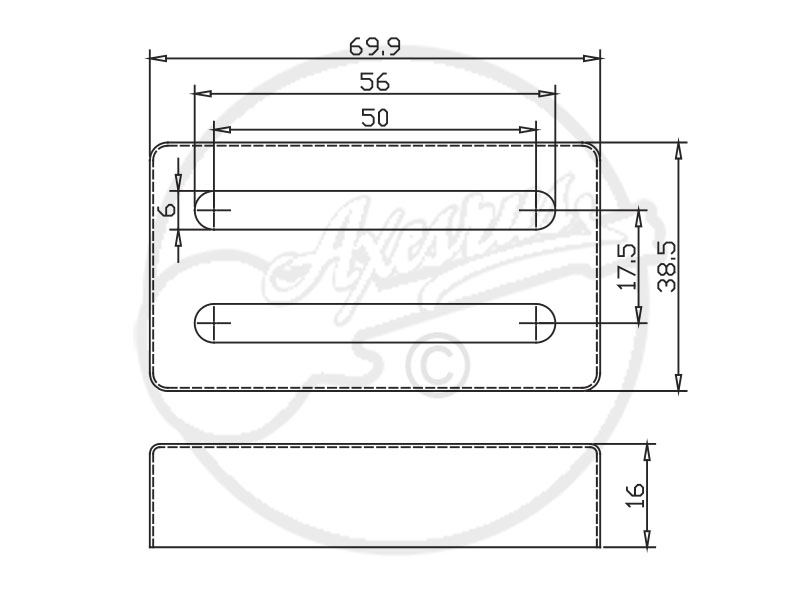
50mm Spaced Dimensions
52mm Spaced Dimensions
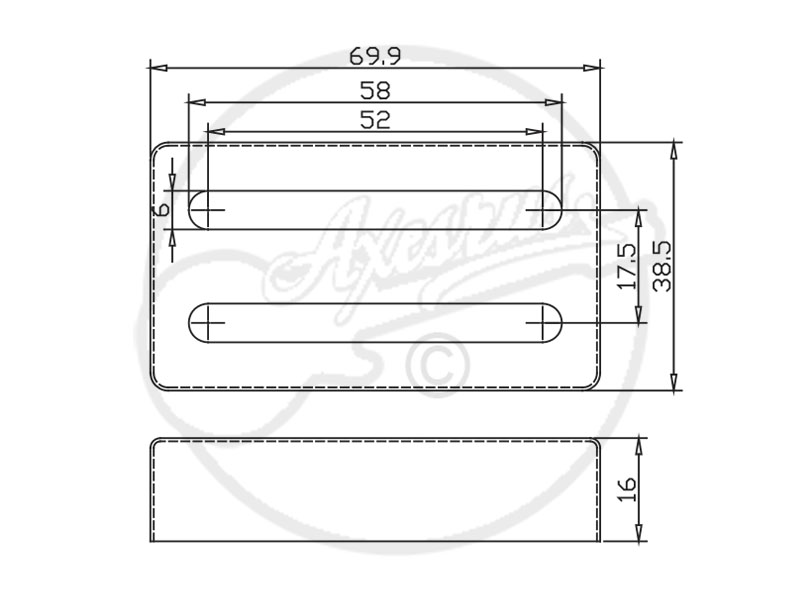
Material - Nickel/German Silver Weight - 23g
|
|
|
 |
|
 |
|

